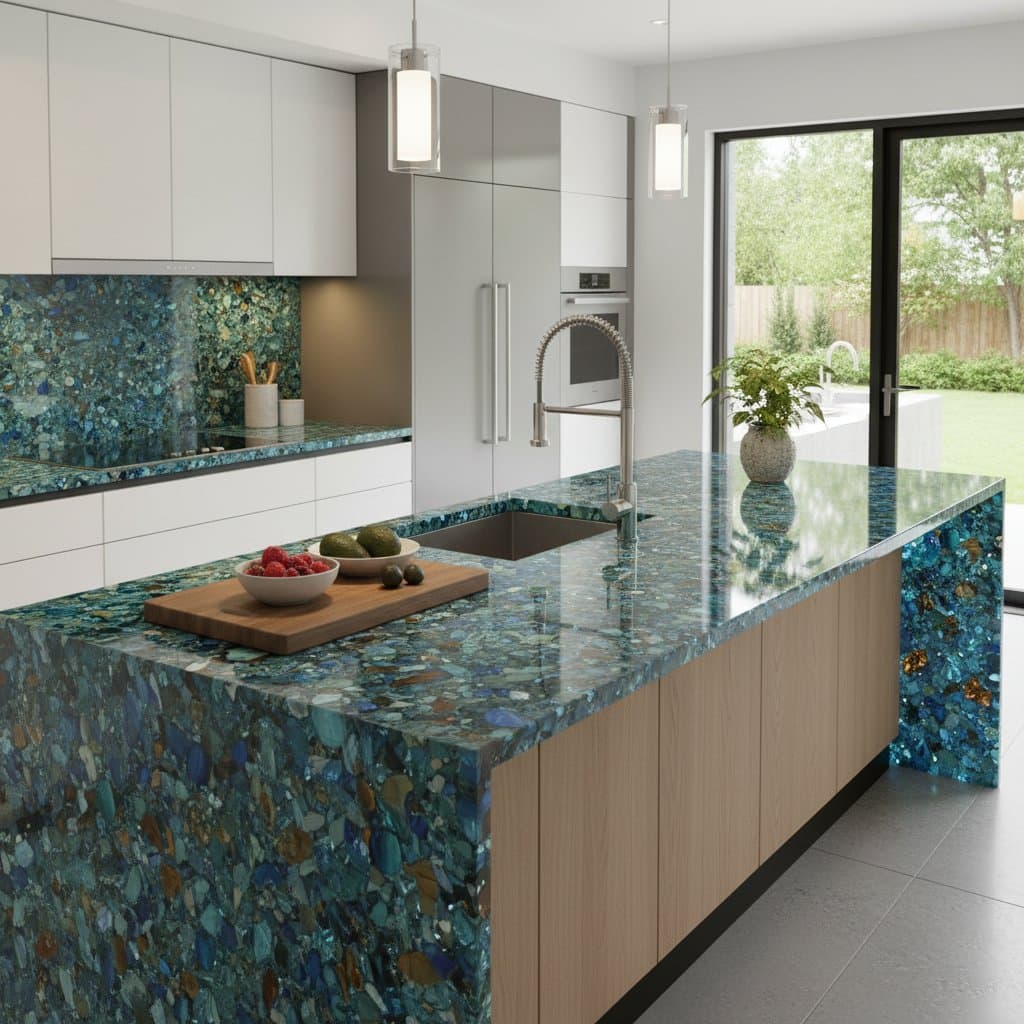
Key Advantages
- Recycled glass countertops merge aesthetic appeal, structural integrity, and environmental benefits into a single innovative surface.
- Expenses fluctuate based on thickness, binding agent, and production techniques, yet their extended return on investment frequently exceeds that of conventional stone materials.
- These surfaces withstand heat, abrasions, and discoloration, simultaneously decreasing landfill contributions and carbon emissions.
- Upkeep remains straightforward, although selecting appropriate sealants and finishes prolongs durability and preserves appearance.
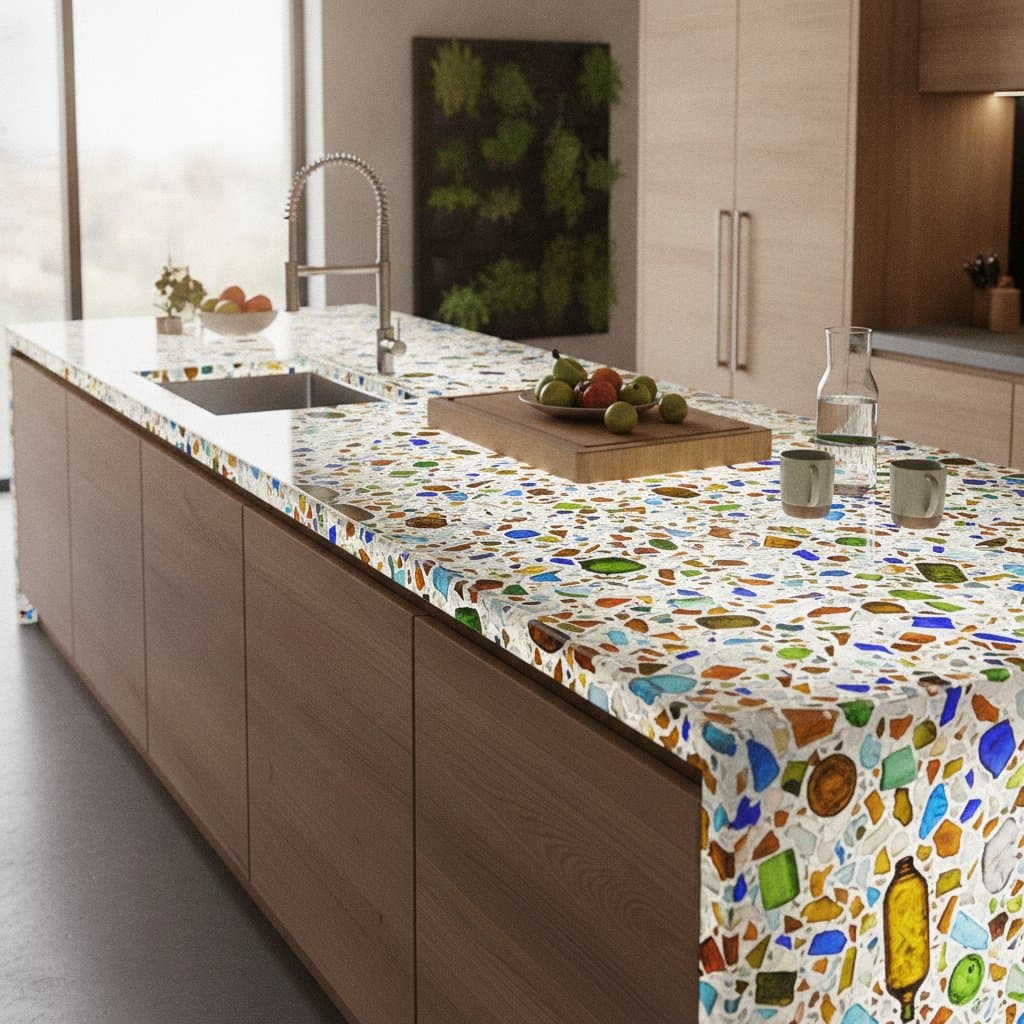
- Design variations span from refined minimalist profiles to vibrant terrazzo-like configurations, ensuring adaptability to diverse kitchen themes.
Addressing Common Kitchen Challenges
Consider the instance when preparing vegetables reveals a countertop marred by scratches or an outdated appearance. This issue extends beyond aesthetics; it signals that the kitchen fails to support daily activities effectively. Countertops endure the demands of meal preparation, gatherings, and routine spills, yet homeowners often overlook them during renovations. The contemporary kitchen serves purposes beyond cooking, encompassing living spaces, entertainment areas, and reflections of personal values via material selections. Recycled glass countertops address these needs as exemplars of sustainable elegance.
Visualize a surface that captures light with a subtle shimmer, derived from transformed bottles, windows, and industrial glass. This material combines sophistication, robustness, and ecological awareness, illustrating that aesthetic and sustainable qualities occupy the same space harmoniously.
Significance of This Emerging Preference
Recycled glass countertops attract increasing attention for compelling reasons. They integrate visual design, practical utility, and ecological principles in a manner unmatched by many alternatives. Homeowners now assess surfaces not only for appearance but also for alignment with lifestyle values. A material embedded in a circular economy narrative provides emotional resonance alongside decorative value.
From an economic standpoint, these countertops yield tangible benefits. Remodeling data indicates that kitchen enhancements recover 50 to 75 percent of costs upon property sale. Recycled glass distinguishes listings, appealing to environmentally aware purchasers willing to offer higher prices. Ecologically, it diminishes landfill accumulation and curtails extraction of raw resources relative to granite or quartz.
Selecting recycled glass represents more than a material choice; it embodies a commitment to a preferable global environment.
Essential Planning Elements
Prior to selecting a recycled glass countertop, evaluate factors influencing expense, functionality, and user experience.
-
Material Composition and Binding Agent
Recycled glass countertops typically incorporate post-consumer or post-industrial glass secured with cement or resin. Cement variants yield a matte texture akin to natural stone, whereas resin options create a polished sheen that accentuates embedded glass fragments. -
Slab Thickness and Edge Configurations
Common thicknesses measure 1 to 3 centimeters. Greater depths produce a substantial, furniture-inspired profile, though they elevate weight and expense. Edge styles, ranging from beveled to cascading designs, affect both visual impact and budget. -
Installation Requirements
These countertops demand professional handling due to their mass. Cabinet reinforcements become necessary for extended surfaces or intricate layouts. Labor expenses generally constitute 20 to 30 percent of the overall project cost. -
Color and Pattern Selections
Options include subdued neutrals with faint glass inclusions or dynamic, mosaic-style assortments. Slabs possess individuality comparable to natural stone, so in-person sample reviews prove essential prior to final decisions. -
Upkeep Protocols
Sealing frequency aligns with binding type. Resin formulations resist stains and seldom require treatment, while cement versions benefit from regular applications to avert surface erosion. Routine maintenance involves gentle soap and water solutions.
Expense Structure and Return Assessment
Costs differ by manufacturer, formulation, and personalization. Installed recycled glass countertops average $60 to $140 per square foot. Basic prefabricated units start at lower rates, whereas bespoke creations with specialized glass aggregates or tailored hues surpass $200 per square foot.
Consider this cost outline:
- Basic Resin Formulations: $60 to $85 per square foot
- Custom Hue Integrations: $90 to $125 per square foot
- Premium Crafted or Thick Profiles: $130 to $200 or more per square foot
Relative to quartz or granite, recycled glass aligns competitively while offering superior ecological attributes. Long-term advantages include enhanced resale potential and diminished maintenance needs. Quality installations endure for decades without degradation, fractures, or substitutions.
Beyond resale, returns encompass eligibility for sustainable certifications that elevate property appraisals. These materials also lessen the homes overall energy profile, appealing to sustainability-focused buyers.
Aesthetic and Spatial Concepts
Recycled glass countertops adapt flexibly to various styles, matching their environmental merits. Options suit preferences from understated elegance to expressive creativity.
- Contemporary Simplicity: Select panels with uniform fine glass particles in neutral shades such as soft white or light gray. Integrate with sleek cabinetry and subdued hardware for a streamlined, modern effect.
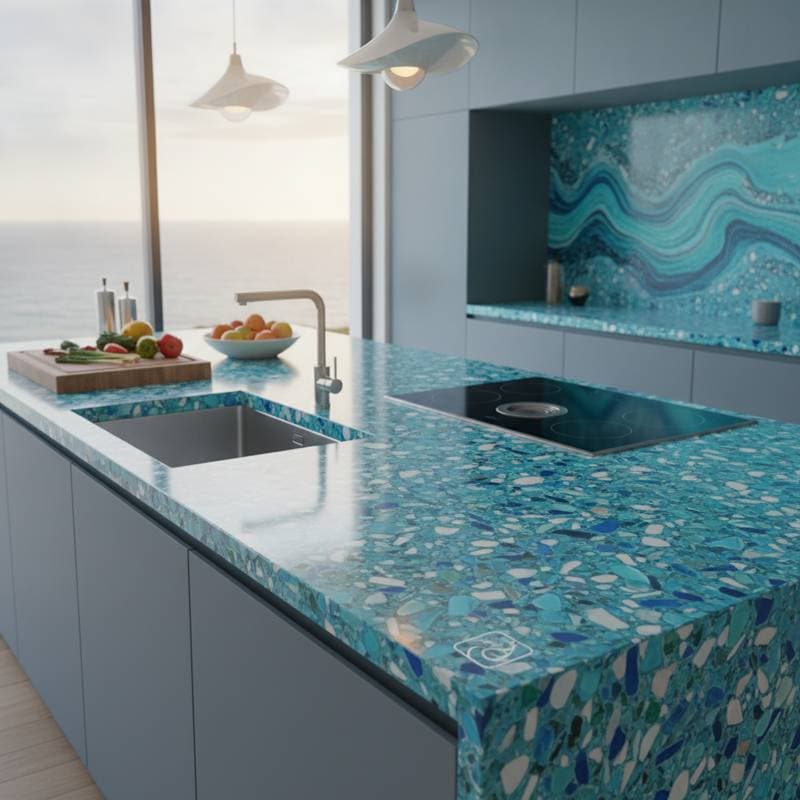
- Seaside Serenity: Employ blends evoking azure or frosted glass tones. Pair with pale timber or natural fiber elements to foster a tranquil, airy ambiance.
- Metropolitan Edge: Favor cement matrices with incorporated reflective fragments for understated gleam. Coordinate with raw masonry or metallic accents to add dimension and character.
- Expressive Focal Point: Incorporate multicolored glass within transparent resin for artistic vibrancy. Such approaches position countertops as integral design features, particularly in expansive kitchen islands.
Slabs uniqueness encourages thoughtful illumination placement to emphasize texture and refraction. Cabinet-integrated lighting or suspended fixtures alter perceptions across lighting conditions, infusing the space with evolving appeal.
Ecological Attributes and Performance Benefits
The environmental narrative of recycled glass countertops proves comprehensive. Compositions feature 70 to 85 percent reclaimed content. This approach substantially lessens reliance on extraction, processing, and energy consumption associated with virgin materials.
Primary ecological merits encompass:
- Waste Diversion: Redirects substantial glass volumes from disposal sites, repurposing items that degrade over extended periods.
- Diminished Emissions: Manufacturing demands reduced energy inputs compared to novel glass production or stone harvesting.
- Health-Conscious Materials: Formulations often exclude harmful volatile compounds, promoting superior interior atmospheres.
- Extended Service Life: Prolonged usability minimizes replacement frequency, thereby curtailing total environmental impact.
Certain variants earn credits in certification systems valuing recycled and low-impact components. Opting for regional production further mitigates transport emissions, enhancing overall sustainability.
Project Variables
Remodeling initiatives involve unpredictable elements. Identify those most affecting budget and outcomes:
- Support Framework: Verify cabinet capacity for load-bearing. Structural enhancements may prove required.
- Fabrication Details: Additional apertures for fixtures, integrated features, or decorative inserts elevate intricacy and charges.
- Regional Expertise Costs: Availability and rates of qualified technicians differ by location.
- Sourcing Origins: Domestic materials shorten timelines and lessen ecological transport burdens.
- Integrated Design: Harmonizing adjacent elements like surrounds or extensions promotes unity but expands material demands.
Budget an extra 10 to 15 percent for contingencies, accommodating variables such as supply fluctuations or refinement adjustments.
Common Inquiries
Question: Do recycled glass countertops match the durability of granite or quartz?
Resin-bound recycled glass equivalents demonstrate equivalent resilience against routine use. Cement-bound types exhibit minor porosity, yet appropriate sealing ensures longevity spanning decades.
Question: Are they prone to scratches or stains?
They outperform many natural stones in abrasion resistance. Discoloration occurs infrequently with resin bindings, although potent acids may affect untreated cement surfaces.
Question: What is the sealing frequency?
Cement formulations require applications every one to two years based on exposure. Resin varieties typically eliminate this need entirely.
Question: Can they support direct heat from cookware?
They manage average temperatures effectively, but protective mats prevent potential resin fractures from sudden changes. Cement options tolerate heat superiorly yet risk fading under prolonged contact.
Question: Are they suitable for food handling?
Yes, their non-absorbent nature inhibits microbial growth. Employ cutting surfaces to safeguard integrity and sanitation.
Question: Do they offer genuine environmental advantages?
Yes, by recycling glass and avoiding new resource depletion, they advance conservation and waste reduction.
Question: Is self-installation feasible?
Professional services are advised. Slabs demand precision handling to avoid damage, ensuring accurate placement and treatment.
Realizing the Upgrade
Anticipate the satisfaction when visitors inquire about the radiant surfaces and learn of their origins from repurposed glass destined for disposal. This narrative highlights renewal for both the kitchen and broader ecosystem. A countertop affirming that ecological choices enhance rather than limit design reshapes perspectives on routine selections.